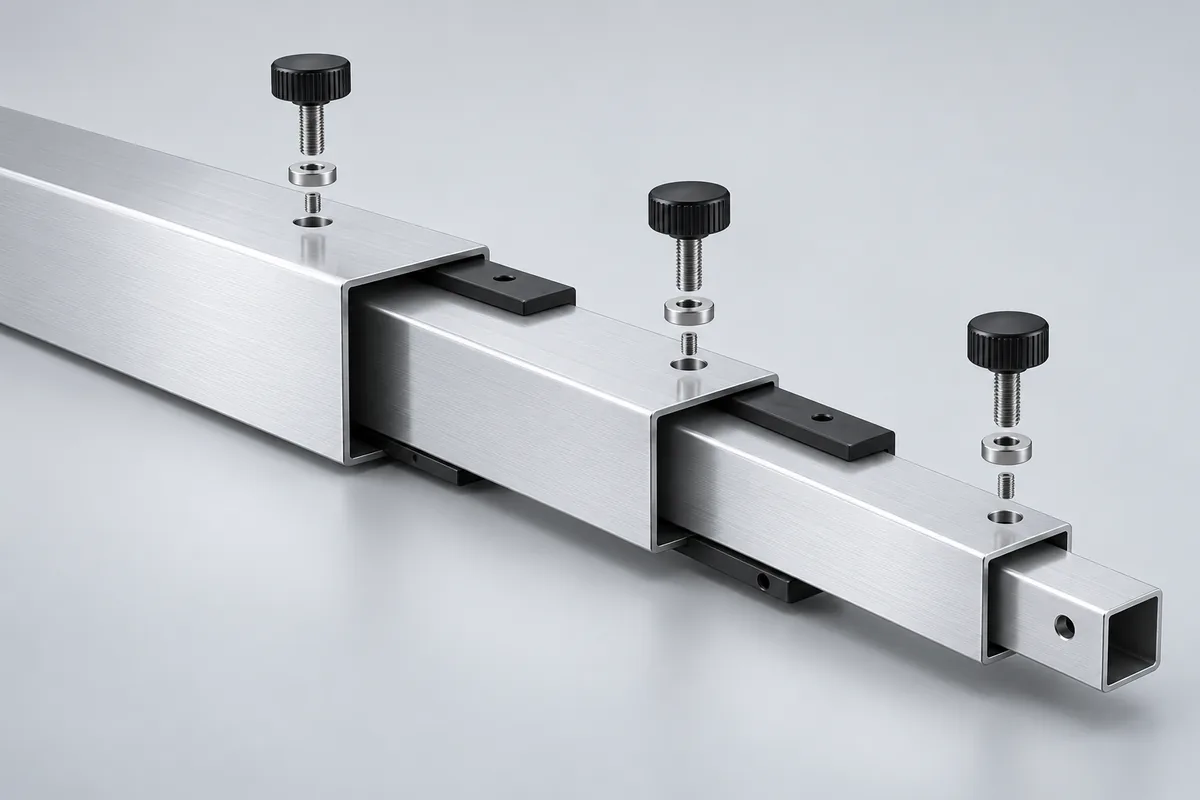
A telescopic assembly needs the inner and outer sections to move together in the intended conditions. A nominal clearance alone does not describe the full sliding interface.
Define the complete section
Review wall variation, corner geometry, twist and straightness alongside the nominal sizes. Specify which surfaces guide the motion and whether separate bushes, pads or guides establish the running fit.
A measured size at one end may not describe the available clearance along the entire travel. The drawing and sample check should reflect where contact can occur.
Plan overlap, travel and retention
State the retracted and extended dimensions, working overlap, stop arrangement and locking method. Brackets, clamps and fasteners need space to operate without interfering with motion.
Loads and the required behavior of the complete assembly must be defined by the application. Component dimensions alone do not establish load capacity or service life.
Evaluate the finished surfaces
Anodizing, coating and contact wear can change the sliding interface. Agree whether fit is checked before or after treatment, which faces require masking and which appearance surfaces need protection during handling.
If polymer guides are used, select their exact grade for the contact pair, lubrication, temperature and humidity. Moisture-sensitive grades can change dimensions during use.
Make the sample checks specific
- Check movement over the defined travel and overlap.
- Assess play or drag using an agreed method.
- Verify stop and locking engagement in the assembled condition.
- Check for surface damage at the actual contact points.
- Define any load, slip or cycle test and its acceptance criteria separately.
Record the Assembly and Measurement Condition
State which guides and fasteners are installed during the fit check, the locking condition and the working orientation. Record relevant conditioning for moisture-sensitive guides and any temperature requirement for dimensional acceptance. A check on loose tube sections can give a different result from the finished assembly. Keep the component revisions and inspection setup with the approved sample record.
Prepare the drawing package
Include both tube sections, the assembly drawing, cut lengths, guides, locking parts, finished condition and operating requirements. Identify matched parts and the revisions used for approval.
See the telescopic tube application note and mechanical assembly overview.